Advocates Lash Back Against Billboards and Voter Intimidation
 By Raisa Camargo, Voxxi
There are seven days left until Election Day, but as noted in several news reports, tactics of voter intimidation in battleground states can still affect voter psychology.
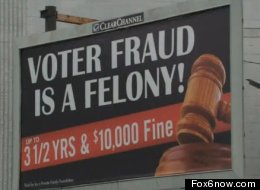
Civil Rights organizations such as the AFL-CIO began to hear cases of billboards popping up in Ohio and Wisconsin earlier in October. An estimated 140 billboards were placed in what media reports highlight as low-income neighborhoods in Cleveland, Columbus and Milwaukee.
 Are the billboards a form of voter intimidation?
The billboards showed a tag line warning the public that there will be criminal consequences for voter fraud. The tag line reads: “Voter Fraud is a felony—up to 3 ½ years and a $10,000 fine.”
Organizations such as AFL-CIO lashed back claiming these messages intimidate voters and particularly communities of color. The billboards were already taken down in Ohio and Wisconsin.
Juan Andrade, founder of the Hispanic Leadership Institute, believes the intended effect is to scare voters and that could potentially affect Latinos who are newly registered voters. He explained that confidence in the process builds up gradually over time.
“New citizens, the last thing they want to do is anything that is illegal or that could be illegal,” said Andrade. “So, if anything suggests that what they may be doing is illegal, they won’t do it. They rather be safe than sorry.”
These battleground states are particularly concerning to strategists and campaign supporters who believe Latino voters will mark the margin of victory. In Ohio, Latinos comprise 3.2 percent of the Latino population.
During a press briefing last week on the Latino vote, Arturo Vargas, executive director of the National Association of Latino Elected and Appointed Officials, stated that “although Ohio may not be a Latino-rich state,” it’s a state where two to three percent of the Latino electorate could “make a difference in a state that’s evenly divided.”
Andrade added that the HLI has been devoted to supporting efforts to take down the billboards in Ohio and other areas. He also wrote a letter to the Mexican American Legal Defense Fund (MALDEF) to go after other voter suppression efforts surfacing in other states like Arizona.
A more aggressive stance against groups that commit voter intimidation
The counterpoint often heard from opposing groups is that they want an “honest election.” These efforts are viewed as protecting the right to vote. Yet, Andrade countered that organizations need to take a more aggressive stance by “embarrassing” those groups who “blatantly” commit voter intimidation.
“You can’t let them off the hook with that kind of lame excuse,” Andrade said when referring to groups like in Maricopa County that attempt to confuse voters. “You have to embarrass them and humiliate them publicly—and go on the air and tell people that they messed up.”
Regarding the billboards, he pressed that those sources need to be held accountable.
The billboards posted in Ohio were owned by Clear Channel, but sponsored by an anonymous source. The company finally stated that this was a violation of its policy against anonymous political ads. Last week, they struck it down in Ohio and Wisconsin after the sponsors of the billboards rescinded.
Clear Channel Outdoor Advertising explained that the sponsors identified as a “private family foundation” stated that they “thought the best solution was to take the boards down, so we are in the process of removing them.”
In Pennsylvania, a similar type of message has been translated into Spanish. The advertising shows a photo of a driver’s license and the lines read, “If you have it, show it.”
Juan Ramos, former city councilman in Philadelphia, expressed outrage at the signs. He is now part of the Delaware Valley Voter Registration Education Project. Ramos exclaimed that the signs could confuse voters, reports CBS news.
The article noted that Pennsylvania Department of Commonwealth countered that, “the billboards are part of the order from the Commonwealth Court judge to educate voters that they will be asked for ID, even if it is not yet required.”
Other ways of voter intimidation are surfacing in other states.
Salon highlighted several of these measures: In Florida, voters in at least 28 counties received false official-looking letters indicating they may be ineligible to vote. In some states, a representative can be sent to polling station to challenge the eligibility of voters they think don’t have a right to vote. In states like Florida, Virginia and Indiana, residents have received phone calls telling them they don’t need to show up at the polls on Election Day, but instead can vote by phone.
In regards to the billboards, it’s still unclear to what extent legal action can be pursued. Andrade said they can be a party to a legal complaint if litigators decide to bring up charges.
This article was first published in Voxxi.
Raisa Camargo is a staff writer at Voxxi.
[Photo courtesy Fox6now.com]