
Breaking the “Vicious Cycle” of Not Voting in Texas
 By Peter Malof, Public News Service
MERCEDES, Texas – Although early voting starts today in Texas, many potential voters do not think participating in elections is worth the bother. In recent years, Texas has consistently ranked near the bottom of all states when it comes to turnout.
It’s a vicious cycle, according to Daniel Diaz, a community organizer for the César Chávez-founded south Texas group known as LUPE (La Unión del Pueblo Entero). Diaz has been organizing get-out-the-vote efforts in the Rio Grande Valley. He says many people who feel routinely ignored by politicians they distrust are too fed up to go to the polls, which further diminishes their political power. If they simply voted in larger numbers, Texas Latinos could have a huge impact, he says.
 “In 2010, we had over 4 million Latino registered voters, but only 25 percent came out. Nearly half the population is Latino, but (they have) very little political power. We also have a large number of permanent residents who haven’t taken the step to become a citizen.”
The vast majority of the 1 million documented permanent residents in Texas are Latino. Polls show most Latinos in the state lean Democratic, but Diaz says that’s another reason many don’t think their votes matter in a deep-red state such as Texas. However, some political analysts say Texas could turn purple – or even blue – if and when the so-called “sleeping giant” Latino electorate becomes more fully engaged.
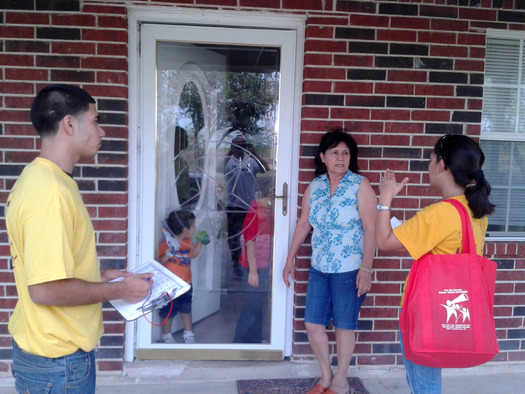
Diaz is part of the Equal Voice Network, which has about 100 door-to-door canvassers in Cameron and Hidalgo counties trying to get out the vote. They are focusing on infrequent voters, urging them to “think locally.” That’s because, although presidential politics may take up most of the oxygen this election season, participation in state-level elections is more likely to have a real impact on Texas communities, he says.
“It’s not about trusting a candidate or a political party; it’s about people trusting their political empowerment as individuals working together with the community. We try to explain that, by increasing the voter turnout, there’s going to be a pool of resources you can ask for, because you’re going to have that political empowerment.”
The valley is one of the nation’s poorest regions. Many communities lack basic services such as paved streets and public lighting. One reason? Diaz says lawmakers don’t tend to steer resources to areas where voter turnout is low.
Early voters can use any polling location in their home county through Nov. 2. Texas voting information is available at https://team1.sos.state.tx.us/voterws.
More details about the Equal Voice Network are at http://rgvequalvoicenetwork.blogspot.com/.
This article was first published in Public News Service.
[Photo courtesy Public News Service]