
The U.S. Latino Story Is Our Story, Let’s Tell It
 By Victor Landa, NewsTaco
First let’s list the things we know about being Latino in the U.S. These aren’t things that have been empirically proven, well promoted and marketed – there is no mainstream-peddled data to back it up.
- Most Latinos in the U.S. are citizens.
- Most Latinos in the U.S. speak English.
- Latino entrepreneurs are job creators.
- U.S. Latinos are professional leaders, philanthropists, civic leaders, elected officials.
- U.S. Latinos are teachers, policemen, engineers, technicians, scientists, artists, craftsmen, priests and politicians…
- U.S. Latinos are young, hard working, educated, honest, and family oriented.
Here’s why I bring these things up: almost everything you hear in the mainstream media about Latinos in the U.S. is related to immigration, and nearly 100% of that is negative. The impression that the majority of non-Latinos get is that U.S. Latinos are undocumented, welfare siphoning, job stealing, Spanish speaking, and uneducated.
But there is a new study that we can point to, a sort of proof of what we know to be true. It was done by Deborah Schildkraut, an associate professor of political science at Tufts University. She surveyed 2,800 U.S. adults of all demographic persuasions – the majority were white – and asked them what they thought different groups felt about the importance of being American. UPI reported on the results:
Schildkraut found respondents generally agreed that being identified as an American was a personal priority regardless of their background. They felt a strong sense of civic obligation, patriotism and trust and embraced basic American values of the love of freedom, the desire for economic advancement and the promise of the American dream.
The majority of Americans, Schildkraut found, are not anti-immigrant. It just feels that way because of all the ruckus being caused by a loud and vocal few on the fringes of the media – and because the fringes have sneaked into the mainstream, we can’t turn a blind eye to that.
So what’s the take-away?
We need to be more active in telling the U.S. Latino story. We need to dig-up the empirical data, put it in a narrative form and use it, share it, and counter the fallacies that have taken hold in the minds of many non-Latinos. It’s our story, after all.
You can begin by sharing this post, and then send me any story, idea, or data that you may come across that builds a true and positive narrative about Latinos in the U.S. because if we don’t do it…
victor@newstaco.com
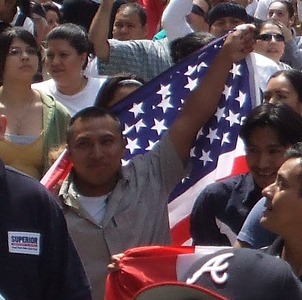
[Photo byVoces de la Frontera]