
Anti-immigrant Sentiment: An American Diversity Gauntlet
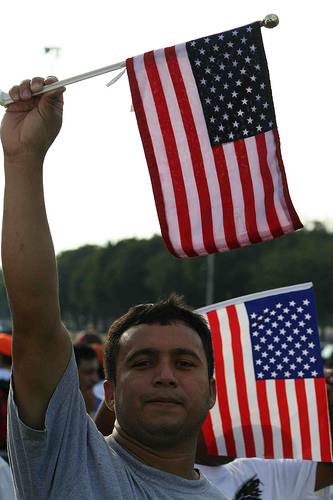
 You have to read this opinion piece in the New York Times, and put it in that memory place where you store things that make sense and are useful when you need to make a point. It was written by Edward L. Glaeser, and economics professor at Harvard, and published in the paper’s Business Day section.
Glaeser celebrates the growing American diversity:
If current trends continue at the same pace — and if my life isn’t cut short by overconsumption of oysters or cigars — I will live to see the 2050 Census measure an even more wonderfully diverse America, where my own demographic subgroup has become a minority.
Immigrants, he says, are changing our urban centers because that’s what immigrants have always done.
The minority population increases are particularly important for the dense urban areas that disproportionately house immigrants and other lower-income individuals. Cities have been gateways into the country for centuries, and they continue to play that role.
Immigrants are a major part of our most successful urban cores, like Boston (27 percent foreign-born) and New York (36 percent foreign-born), but they also swell the population of small cities like Lawrence, Mass. (34 percent foreign-born), and Yonkers (29 percent foreign-born).
The ability to get around without buying cars is worth a lot to people who have just come to this country.
This reminded me of a conversation I once had with the late Willie Velasquez. I was a young reporter and would volunteer to interview Willie every week because those interviews were, for me, more like school than work. I’d forget about the microphone and the camera and listen. He said once, referring to the anti-immigrant rhetoric that was being felt almost thirty years ago, that every wave of immigrants coming to America went through a gauntlet where they were at first rejected. Glaeser writes:
Every increase in American diversity has seen a political reaction. The American, or Know-Nothing, Party began in the 1840s in response to large numbers of Catholic immigrants from Germany and Ireland who seemed so jarring to our then-overwhelmingly Protestant population. In 1882, Congress passed a Chinese Exclusion Act. And the millions of immigrants from Eastern Europe evoked a fearsome tide of anti-immigrant politicking that gave us the Emergency Quota Act of 1921, which restricted immigration based on nation of origin.
Our own age has also seen plenty of politicians pushing an anti-immigrant, or at least anti-illegal-immigrant, agenda.
“It’s our turn through the gauntlet,” Willie said.
America’s diversity has grown to such an extent that the nativists have lost political power and clout. And from an economic point of view, America’s diversity is it’s lifeline.
The world is a big, diverse place and America will be better able to help lead that world if our country is also big and diverse. When we let in skilled immigrants with H1B visas, we get the expertise that will power our productivity for decades to come. William R. Kerr’s research shows the deep increase in patents awarded to Chinese and Indians living in the United States.
When we let in less-skilled immigrants, we are fulfilling America’s promise as a place of opportunity for everyone – a promise that was offered to all of our ancestors.
Follow Victor Landa on Twitter: @vlanda
[Photo by ElvertBarnes]